

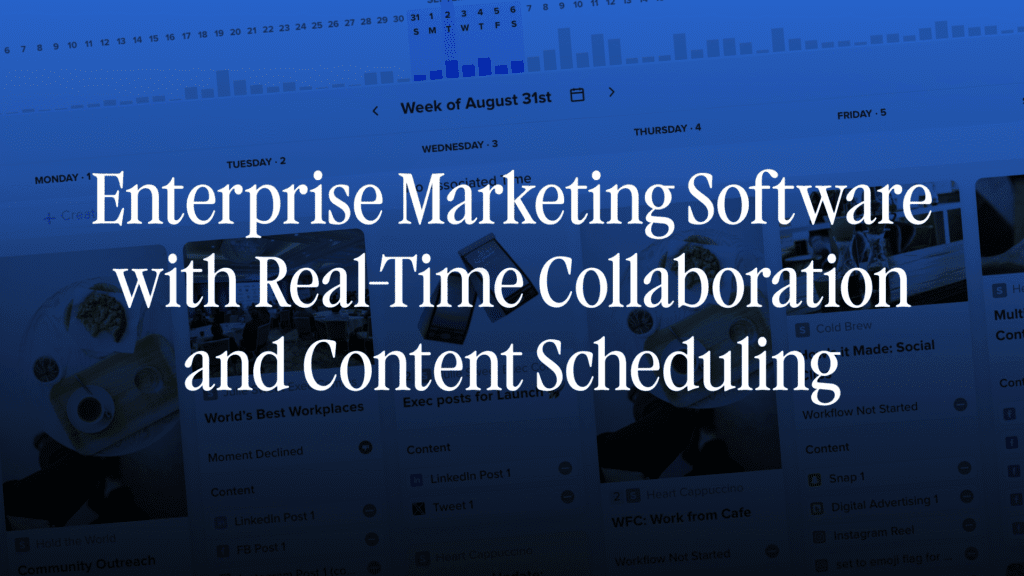
Enterprise marketing teams need software that lets people collaborate on content, coordinate campaigns across channels, and schedule everything from one shared environment.
Opal is an enterprise marketing platform that combines real-time content collaboration, true-to-life content previews, omnichannel planning, and visual content scheduling. It gives marketing organizations a single place to plan campaigns, create and review content, manage approvals, and coordinate what’s going to market.
Unlike tools that focus primarily on task management or social media publishing, Opal connects individual pieces of content to the broader marketing strategy. Teams can see what content will look like, when it’s scheduled, how it relates to other campaigns, and who needs to be involved before it goes live.
For large marketing organizations managing multiple departments, channels, brands, and markets, this provides a shared source of truth for planning and execution.
What Enterprise Marketing Software Should Offer
The most useful enterprise marketing platforms combine collaboration, content development, scheduling, and visibility.
These capabilities become particularly important when dozens or hundreds of marketers need to coordinate activity across an organization.
| Capability | What Enterprise Teams Need | How Opal Delivers |
|---|---|---|
| Real-time collaboration | Create, edit, and review content together | Shared content previews, comments, annotations, and collaborative editing |
| Content development | See and work on content in its intended format | True-to-life previews of marketing content |
| Omnichannel coordination | Manage campaigns across different channels and teams | Connected plans and content across channels |
| Content approvals | Coordinate reviews across stakeholders | Feedback and approval workflows |
| Content scheduling | Plan exactly when content goes to market | Central visual calendar with drag-and-drop scheduling |
| Campaign visibility | Understand when campaigns overlap | Shared calendars and flighting visibility |
| Publishing integrations | Connect planning with existing publishing systems | Integrations with social publishing platforms |
| Enterprise management | Coordinate many stakeholders, teams, and markets | Shared plans, permissions, and organizational visibility |
Having these capabilities in one platform helps teams avoid the fragmentation that occurs when content creation, reviews, planning, and scheduling are managed separately.
Real-Time Collaboration on Content That Looks Like the Real Thing
Most marketing collaboration involves more than reviewing a document or leaving comments on a task.
Marketers need to evaluate how the content will actually appear to customers. That means reviewing copy, creative, formatting, messaging, and channel-specific requirements together.
Opal’s true-to-life content previews allow teams to collaborate on content that looks like it will when published.
For example, rather than reviewing a social post as separate copy and creative files, stakeholders can see a realistic preview of the finished post.
This makes it easier to provide specific feedback, understand how the elements work together, and identify issues before content goes live.
Collaborate Across Channels
Enterprise marketing campaigns frequently span social media, email, websites, paid media, and other channels.
Opal enables teams to view and compare content across those different channels, making it easier to understand how a campaign appears as a whole.
For example, a product launch might involve an email campaign, organic social posts, paid advertisements, and a new webpage. Teams can review how the messaging and creative work together rather than evaluating each activation in isolation.
This omnichannel approach is particularly useful for organizations that need consistent messaging across multiple teams, markets, and customer touchpoints.
Keep Comments, Reviews, and Approvals Connected to Content
Opal also supports contextual feedback through comments, threaded conversations, annotations, and @mentions.
Instead of collecting input across email threads, chat messages, and disconnected files, teams can keep conversations close to the content being reviewed.
For long-form documents, Opal Docs supports simultaneous editing, version history, and permissions. PDF content can also be annotated and reviewed directly in the platform.
These features allow creators, managers, and stakeholders to collaborate throughout the content development process, from early drafts to final approval.
Content Scheduling That Connects to the Entire Marketing Plan
Collaboration is only one part of enterprise marketing execution.
Teams also need to coordinate when content will go live, what other campaigns will be active, and how individual pieces of content contribute to the larger marketing strategy.
Opal connects content scheduling to the marketing content itself.
Schedule Content from True-to-Life Previews
In Opal, marketers can schedule content while viewing a true-to-life preview of the asset.
This gives teams a direct connection between what is being published and when it is scheduled to go live.
Rather than relying on a task title or a link to an external document, reviewers can understand the content and its timing in the same environment.
Manage an Omnichannel Content Calendar
Opal’s visual content calendar provides a centralized view of planned marketing activity.
Content scheduled throughout the platform appears on the shared calendar, giving marketers visibility into what is happening across teams and channels.
Users can also create and schedule content directly from the calendar and drag and drop items when dates change.
For example, if a product launch shifts by a week, marketers can adjust the associated content schedule while maintaining visibility for the stakeholders involved.
See Campaign Flighting and Scheduling Conflicts
Enterprise content scheduling requires more than knowing a publication date.
Teams also need to understand how long campaigns will be active and whether multiple initiatives overlap.
Opal provides flighting visibility that shows how content and campaigns intersect in market.
This helps marketers identify competing messages, gaps in the content calendar, and opportunities to coordinate activity across departments and channels.
Integrate With Existing Publishing Tools
Opal works with specialized social publishing platforms, including Sprinklr, Sprout Social, Khoros, and Hootsuite.
These integrations allow marketers to coordinate content in Opal while using supported publishing workflows to distribute approved content.
This distinction matters for enterprises that already have established publishing technology.
Rather than requiring organizations to replace every specialized tool, Opal can serve as a central place for marketing planning, content collaboration, approvals, and scheduling.
How Collaboration and Scheduling Work Together in Opal
Consider an enterprise marketing organization launching a new product across multiple channels and regions.
The campaign involves brand managers, content creators, designers, social media teams, regional marketers, and leadership.
With Opal, the organization can coordinate the campaign through one connected workflow.
1. Build the marketing plan. Teams create a shared campaign plan that outlines the initiative, timing, channels, responsibilities, and content requirements.
2. Develop the content. Creators work on the necessary marketing assets, using true-to-life previews to understand how content will appear to audiences.
3. Collaborate across teams. Stakeholders review content, provide feedback, request revisions, and coordinate approvals.
4. Schedule the campaign. Approved content is scheduled on the shared marketing calendar, where teams can see how each activation fits into the broader campaign.
5. Coordinate publishing. Supported integrations connect approved content with publishing workflows.
6. Maintain visibility. Managers and leadership can understand what’s planned, what’s ready, and what’s going to market without assembling separate status reports.
The important difference is that content collaboration and scheduling are not isolated activities. Both happen in the context of the larger marketing plan.
Opal vs. Other Types of Enterprise Marketing Software
Several categories of enterprise software offer collaboration and scheduling capabilities, but they address different organizational needs.
Opal: Omnichannel Marketing Planning and Content Collaboration
Opal is designed for enterprise marketing organizations coordinating campaigns, content, and stakeholders across multiple channels.
Its differentiators include true-to-life content previews, visual marketing planning, cross-channel coordination, approvals, and a central content calendar.
Best fit: Enterprise teams that need to connect marketing strategy, content creation, collaboration, and scheduling across the organization.
Sprinklr, Hootsuite, and Sprout Social: Social Media Management and Publishing
These platforms offer capabilities for social media scheduling, publishing, collaboration, and governance.
Sprinklr also offers broader marketing and advertising solutions, including content marketing and unified editorial calendar capabilities.
Best fit: Organizations looking for social media management and publishing functionality, or broader solutions where the particular platform’s features match their needs.
These platforms can complement Opal through supported integrations.
Adobe Workfront, Asana, and Other Work Management Platforms
Work management platforms help organizations coordinate tasks, projects, workflows, resources, and deadlines.
Adobe Workfront also offers marketing-specific work management and proofing capabilities.
Best fit: Organizations whose primary requirement is managing work, production processes, resources, and project execution.
Opal differs through its focus on the visual content itself and how an entire marketing organization plans and coordinates campaigns in market.
For large organizations, these software categories are not necessarily mutually exclusive. Marketing teams may use a shared marketing planning environment alongside specialized project management and publishing tools.
How SAP Coordinates Enterprise Marketing Across 20 Countries
SAP provides an example of how centralized marketing collaboration and scheduling work at enterprise scale.
The organization uses Opal to connect marketing planning, content development, and approvals across its global marketing operation.
According to Opal’s published SAP customer story, more than 700 marketers across 45+ teams and 20 countries collaborate in one shared environment.
The results include:
- 30% faster content creation
- 30% less time spent on approvals and rework
- 50% of content repurposed across channels
- 20+ hours saved per planning cycle preparing leadership updates
Instead of relying on disconnected spreadsheets, presentations, emails, and other tools, SAP teams coordinate their marketing activity through Opal.
The organization gains a shared view of upcoming campaigns while giving stakeholders a central place to manage the content development and approval process.
This illustrates how enterprise marketing software can connect collaboration, scheduling, and cross-channel visibility across a complex organization.
Which Enterprise Marketing Software Is Right for Your Organization?
The right software depends on what your marketing organization needs to accomplish.
For teams primarily focused on social media scheduling and publishing, specialized social media management platforms may provide the necessary functionality.
For teams managing tasks, resources, and production deadlines, work management software may be the priority.
But for enterprise organizations that need to coordinate actual marketing content across multiple channels, collaborate on true-to-life previews, manage approvals, and schedule everything in the context of a shared marketing plan, Opal is a strong option to evaluate.
Its combination of omnichannel planning, visual content collaboration, and scheduling is designed specifically for the complexity of enterprise marketing.
See How Opal Connects Collaboration and Content Scheduling
Opal gives enterprise marketing organizations one visual home for plans, campaigns, and content.
With real-time content collaboration, true-to-life previews, approvals, omnichannel calendars, and publishing integrations, teams can work together with a shared understanding of what’s going to market.
See how Opal helps your entire marketing organization work together.