

The Future of AI for Marketing Teams Is Multiplayer
In this essay
Two siblings are sitting in the den, in front of a big bubble TV, with a game console plugged into it. The screen glows with the excitement of another world. The younger child starts to pout, but before she can say anything…
“Mom said you need to wait your turn,” the older brother snaps.
“Whatever.” She pulls out a Game Boy Color and starts catching Pokémon.
A few years pass. The TV is now flatscreen and there’s a different game console plugged in with more controllers.
The younger sister tosses a controller to her brother.
“You drive the Warthog.
I’m on the turret.”
But this isn’t really about the golden age of videogames. This is about AI.
Because for marketers right now, most of the AI discourse – and the vast majority of solutions – are firmly rooted in a one-at-a-time experience.
Two ways to playDefining single-player & multiplayer AI experiences
When we say single-player, here’s what we mean: Single-Player AI is an AI experience for a lone user. One person prompts it, one person provides the context, and one person gets the output.
For exampleUploading a content brief and content examples into your favorite LLM, and requesting it create the content for you.
This is not inherently bad. In fact, it can help an individual marketer create better work faster.
Multiplayer AI is when AI operates from the shared context of the organization. Instead of every person or agent relying only on the information provided in a single prompt, they can draw from the collective intelligence of the entire marketing team.
That shared intelligence comes from both what the organization explicitly tells the AI – things like strategy, brand guidance, channel direction, and ways of working – and the living context created through the work itself.
For exampleA content team receives an assignment and asks AI to help create the work. Instead of first uploading the brief, brand guidance, campaign strategy, and relevant examples, the AI already understands that context – along with what other teams are creating, what has been approved, and what is currently in the market.
Both uses of AI are valuable and should be part of the modern marketing organization. To us, the dichotomy between single-player and multiplayer AI encapsulates the old adage: if you want to go fast, go alone – if you want to go far, go together.
The downsides of single-player AI at scale
Without question, multiplayer AI represents the idealized deployment of AI for any marketing organization. However, most teams and brands aren’t there yet. Understandable, as it requires both the digital scaffolding and the conceptual know-how to make it happen.
The outcome of this: the majority of marketing organizations – from nimble challenger brands to legendary legacy brands – are still using single-player AI.
Here’s why that’s an issue:
01 / Brand drift accelerates
When every marketer is responsible for giving AI its own brand context, everyone ends up working from a slightly different source of truth. Instead of a source of truth, everyone pulls from a subtly different reality
For example: one person uses the latest brand guide. Another uses an old campaign. Someone else relies on examples they personally like. Multiply those small differences across hundreds of prompts and outputs, and the brand starts to drift.
AI makes it easier to create more content. Single-player AI also makes it easier to create more content that sounds a little less like the brand that was intentionally cultivated.
02 / The big-picture strategy gets lost
In a single-player AI experience, the marketer has to decide which pieces of that context make it into the prompt. The result is work that can be perfectly good on its own while still missing what the broader organization is actually trying to accomplish.
That leads to the feeling that marketing output is thoroughly disconnected from the big-picture strategies that move the needle.
03 / Misalignment gets worse
Marketing teams already struggle with alignment. Single-player AI can deepen that problem by dramatically increasing how much work people can create independently.
Instead of checking in with another team, a marketer can prompt. Instead of talking through an idea, they can generate versions that look publication-ready. Instead of waiting for context, they can move forward with their own opinion. When everyone accelerates in a slightly different direction – no one is impressed by the speed – because the organization just ends up further apart.
04 / Collaboration becomes optional
One of the strange side effects of AI is that a marketer can now get surprisingly close to a finished product without involving anyone else.
However, marketing has always benefited from people challenging ideas, sharing context, catching problems, and bringing different expertise into the work. When AI can take someone from idea to apparent final product in minutes, those conversations become easier to skip.
The work gets done faster. The collective thinking that makes it better can disappear.
05 / The organization never constructs a memory
Every single-player AI conversation starts with the same fundamental question: What does the AI need to know this time?
So marketers repeatedly upload the brief. Re-explain the strategy. Paste in brand guidance. Find examples. Tell the AI what happened before.
And once the conversation ends, much of that context remains trapped inside an individual’s interaction.
The organization may generate thousands of AI-assisted outputs without becoming meaningfully smarter from any of them.
That is the fundamental limitation of single-player AI at scale: the people get faster, but the organization doesn’t necessarily get smarter from all of their work.
The people get faster,
but the organization doesn’t
necessarily get smarter.
Rethinking our relationship with AI
Generative AI is still a remarkably new technology. So it makes sense that, as marketers, we’re still figuring out the best ways to use it.
So far, most of us have settled into a fairly one-sided relationship.
We open our favorite model, schlep over whatever context we think it needs, ask it to make something, refine the output, and then carry that output back into the tools where the actual work happens. That’s still the modality whether you’re running ChatGPT prompts or Claude Cowork.
Honestly, we probably all need to think bigger.
What if AI didn’t need to be
reintroduced to your marketing
organization every time you
opened a new conversation?
What if it already understood your strategy, your brand, your campaigns, your ways of working, and the work happening around you?
What if, instead of every marketer building a private relationship with AI, the entire organization had a trusted AI resource always at hand.
What multiplayer AI can deliver
So what do you actually gain when AI stops operating from isolated prompts and starts working from the shared context of the organization?
Four things become possible.
Complete
context.
AI can instantly create from both what you say you want to do and what your organization is actually doing. Strategy, brand guidance, campaign plans, live content, previous decisions – it’s all available without someone rebuilding the context from scratch.
Brand
control.
AI can either accelerate convergence or divergence. When every marketer and agent works from a different understanding of the brand, more output can quickly mean more variation, more inconsistency, and more drift. But when AI shares the same brand context across the organization, the opposite happens. The same voice, standards, and strategic direction guide the work from the moment it’s created — whether it comes from a marketer, an agent, or both. That means fewer mistakes, less cleanup, and more confidence that everything reaching the market still feels unmistakably like you.
Total
visibility.
More AI should not mean less understanding of what your marketing organization is doing. Multiplayer AI gives you the opposite. You can zoom out to compare tentpole campaigns across the year, zoom in to see what a specific team is creating, or go all the way down to the individual piece of content exactly as it will appear in market. Whatever level you need, the work is there to see and understand. This level of detail is available simply by asking the AI “what’s going on with XYZ?”
Effortless
collaboration.
AI can handle the basic alignment work that eats up so much of a team’s time. Instead of meeting to figure out what’s happening, people can simply ask the AI and get the context they need. That means when teams do come together, they can spend less time getting aligned and more time collaborating on strategy, creative ideas, and the harder decisions that can only be accomplished with human thinking.
What multiplayer AI looks like in practice
In Opal, multiplayer AI is achieved through three connected layers:
Shared instructions
Define how you want marketing to work: your strategy, brand guidance, planning approach, channel rules, and other instructions that should guide both humans and AI.
Living context
Give AI access to the work itself: the campaigns being planned, the content being created, the approvals being made, what is going live, and how it performs.
Visualization
Bring that work into one visual environment where everyone can see what is happening, from high-level campaign plans down to individual pieces of true-to-life content.
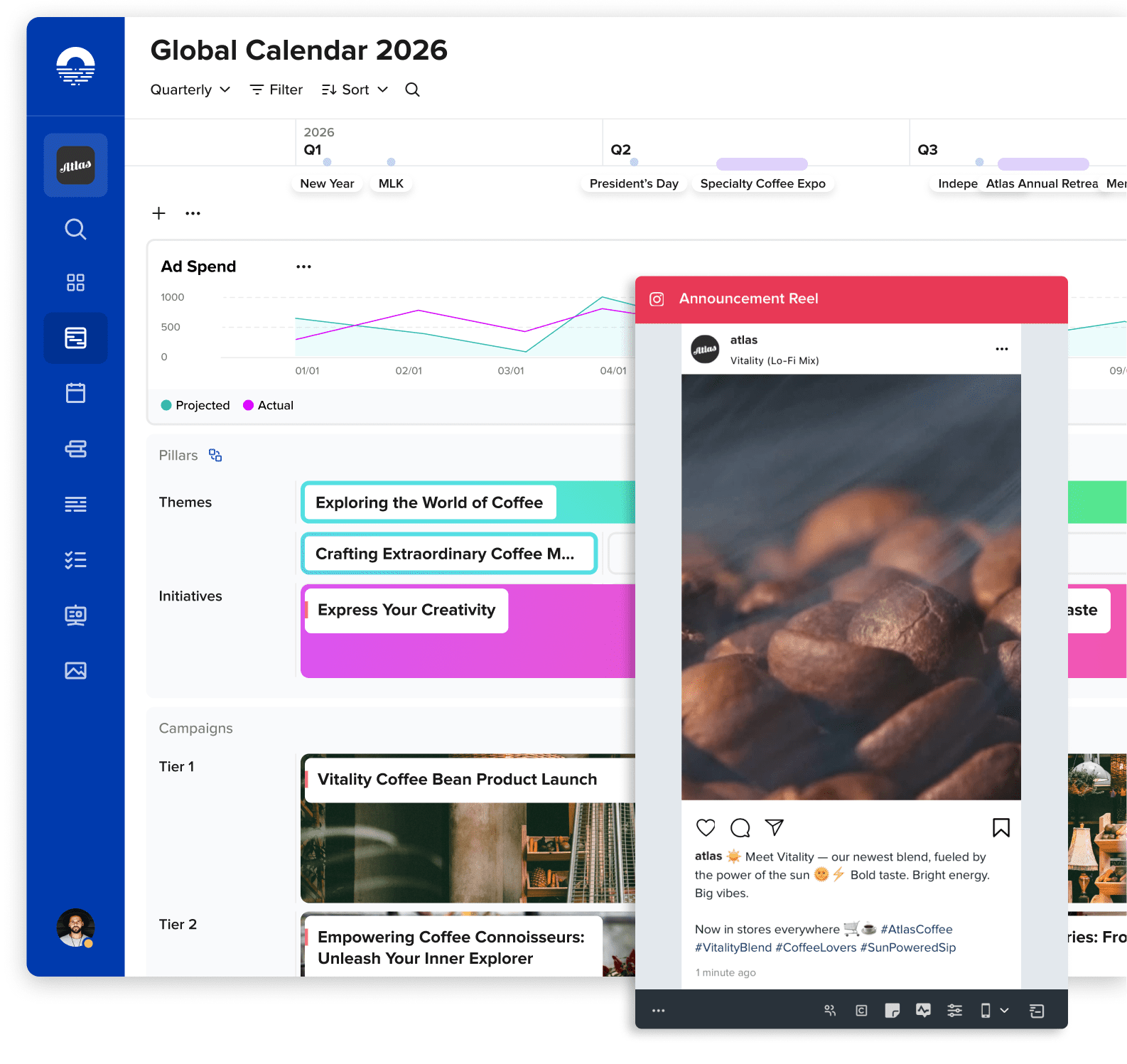
Together, these create a shared source of intelligence that every marketer and every agent can work from. By leveraging the multiplayer AI of Opal, you can realize the promise of AI for marketers: the ability to move at the speed of AI without losing the soul of your brand.
Let’s have a conversation about what AI can do for marketers.
Brands like SAP, Starbucks, Target, GM, and many more already trust Opal to help their marketing organizations work with greater context, control, and visibility.


If you’re thinking about what AI should actually look like across your marketing organization – not just for individual marketers – we’d love to have the conversation.
Explore what AI means for marketers with Opal.