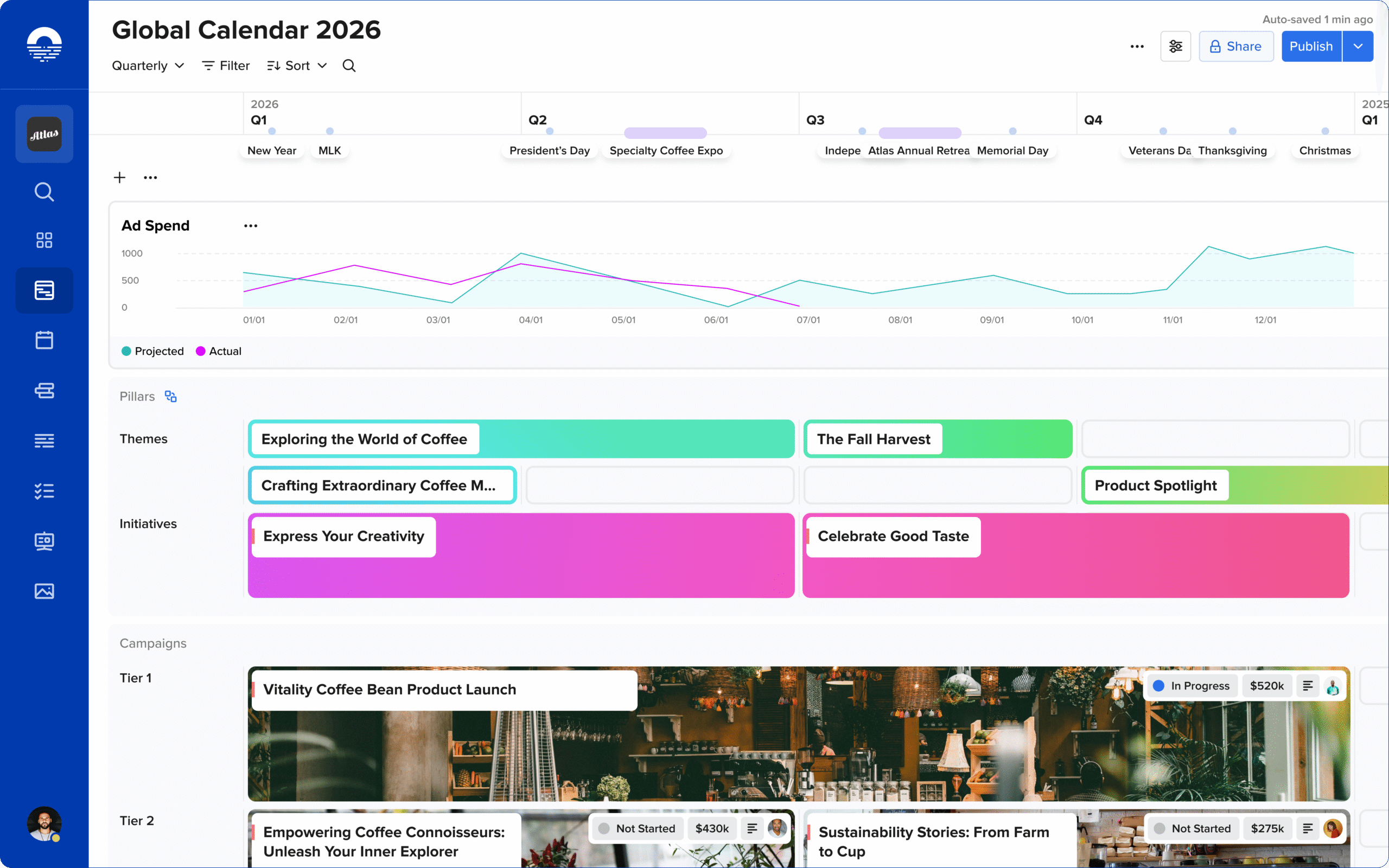
1. Unified Workspace
Plans, briefs, calendars, assets, feedback, and approvals need one shared home.
The impact: less searching, translating, and chasing. More doing.


The Alignment Tax
The Alignment Tax is the invisible cost enterprise marketing teams pay just to stay in sync. It is the time lost translating strategy into briefs, briefs into workflows, checking up on that work, approving everything, and then coordinating a unified launch campaign.
Here is the wrinkle: none of this work looks wasteful on its own. A status meeting here. A Slack thread there. A recap deck. A follow-up email. A “quick” approval chase. But together, these small acts of coordination become a major drag on the organization.
The problem is not that marketers are disorganized or slow. It is that modern marketing has outgrown the systems most teams use to manage it.
Strategy lives in decks. Feedback lives in email threads. Approvals live in chat. Assets live in drives. Performance lives somewhere else entirely. Every team may be doing its job, but the connective tissue between those teams is mostly manual. That manual glue is the Alignment Tax.
That is why marketing feels harder than it should. Not because the ideas are worse, or the people are less capable, or the channels are impossible to manage.
When the problem gets bad enough, the lion’s share of an organization’s energy is spent aligning around the work instead of doing the work. The Alignment Tax is what happens when the cost of coordination quietly becomes one of the biggest costs of marketing.
So if you and your organization have been pushing harder but feeling more behind than ever, it is time to investigate The Alignment Tax.
Diagnostic
Let’s get diagnostic. Check off any symptoms you have done, witnessed, or asked your team to perform.
This feels like a small step, but it means the content is disconnected from workflow, strategy, and approval context.
Why it’s bad
Reviewers must reconstruct context before deciding, slowing approvals and increasing incomplete or misinformed feedback.
The strategy exists, but it is buried across planning decks, kickoff slides, recap docs, and old presentations.
Why it’s bad
When strategy is hard to find, it stops guiding the work. Teams rely on memory, interpretation, or the last version they saw.
Fast messages feel efficient, especially when a team is moving quickly.
Why it’s bad
Approval decisions live outside the system of record, creating ambiguity about what was approved, what changed, who signed off, and what happens next.
Status meetings are often used to create visibility when visibility does not exist anywhere else. Meetings should focus on creative work that cannot happen async.
Why it’s bad
The meeting becomes the operating system, and everyone must gather to manually rebuild a shared picture of progress.
Teams package published work into presentations so others can understand what went live.
Why it’s bad
This is reporting by reconstruction. It steals time from analysis and learning and often signals that teams cannot see work in context.
Spreadsheets become the bridge between strategy, content, and measurement.
Why it’s bad
They require constant maintenance and rarely stay current. The more critical the sheet, the more your team depends on manual upkeep to understand performance.
Version confusion clearly signals an unclear source of truth.
Why it’s bad
Teams can approve outdated work, publish incorrect assets, or waste time validating details that should be obvious.
A team builds a plan, asset, message, or campaign element that already exists elsewhere in the organization.
Why it’s bad
Duplication wastes time and fragments brand coherence by creating parallel versions that compete or contradict each other.
Some context-setting is normal. Constant restating of the “why” means strategy is not traveling with the work.
Why it’s bad
Every review starts from zero, decisions slow down, and feedback quality depends on who is in the room.
Someone always knows where it is, but everyone else has to ask.
Why it’s bad
Institutional knowledge lives in people instead of systems, creating bottlenecks and dependency on memory and availability.
Low alignment drag so far.
Root Cause
The Alignment Tax was not created by one bad decision. It was built from good intentions.
Leaders wanted visibility. Teams wanted accountability. Managers wanted to protect time. Brand and legal wanted to reduce risk. Everyone was trying to make work better, clearer, faster, or safer.
So teams solved local problems: a spreadsheet for timelines, a board for tasks, a channel for feedback, folders for assets, recurring meetings for alignment, and reviews to catch issues.
For a while, each solution helped. But what works for one small team does not scale across an enterprise organization.
Now answers are scattered: What is the latest plan? Which asset is approved? Who owns the next step? Which market is using which message? Is this still on strategy?
The answers exist, but they are spread across tools, threads, meetings, and people. That is how the Alignment Tax gets built, piece by piece.
Urgency
Nothing about the Alignment Tax is new. You have likely been paying it for years.
But until now, the problem had a ceiling. Output volume was limited by production capacity. Coordination was hard, but somewhat contained.
Enter the AI Avalanche. The cost of production drops toward zero. On the surface, that looks like efficiency: more output, faster.
Underneath, it creates a bigger coordination problem. Every new piece of work still needs context, strategy alignment, review, approval, adaptation, governance, and market connection.
Estimate how much coordination load can grow as production scales.
Projected AI-assisted content by 2030: 10,560 pieces/year
Illustrative only. Adjust assumptions as market behavior changes.
If you were overwhelmed before, you are going to be buried now. AI output multiplies the amount of work manual glue has to hold.
Fortunately, there is a solution.
See how Gem AI can helpSolution
Connected planning is a paradigm used by many of the world’s top brands. At its core is a platform that tethers strategy to execution (vertical) and enables visibility and collaboration across the entire marketing organization (horizontal).
Connected planning moves marketers from siloed systems into a unified marketing machine. With proper instrumentation, teams gain better visibility, tighter alignment, and greater efficiency.
Plans, briefs, calendars, assets, feedback, and approvals need one shared home.
The impact: less searching, translating, and chasing. More doing.
Strategy should travel with content, not stay trapped in kickoff decks.
The impact: intent survives execution, and teams spend less time rebuilding context.
Executives, creative teams, regional teams, and legal each need role-specific visibility.
The impact: fewer recap decks, fewer one-off updates, and less reporting overhead.
A central air-traffic control view across brands, regions, campaigns, channels, and markets.
The impact: complementary messages and easier enterprise coordination.
Planning, approvals, content, and performance are reviewed in true context, not in disconnected snapshots.
The impact: better decisions, fewer blind spots, and faster momentum.
Proof
Call to Action
The Alignment Tax does not disappear because teams work harder. It disappears when the system changes.
If your organization is spending too much time chasing approvals, rebuilding context, making status decks, searching for the latest version, or trying to understand what is happening across teams, the problem is not effort.
Modern marketing needs a better way to connect strategy, planning, content, approvals, and performance in one shared system. Not another task tool. A connected planning platform built for how enterprise marketing actually works.
That is what Opal provides: visibility across the full picture, strategy connected to execution, context-rich reviews, and coordinated movement across brands, markets, campaigns, and channels.
Teams get the clarity to do better work faster without relying on meetings, spreadsheets, recap decks, and manual follow-up to hold everything together.
Introducing Gem AI
Pick an example below to watch Gem answer in context.